
Anúncios
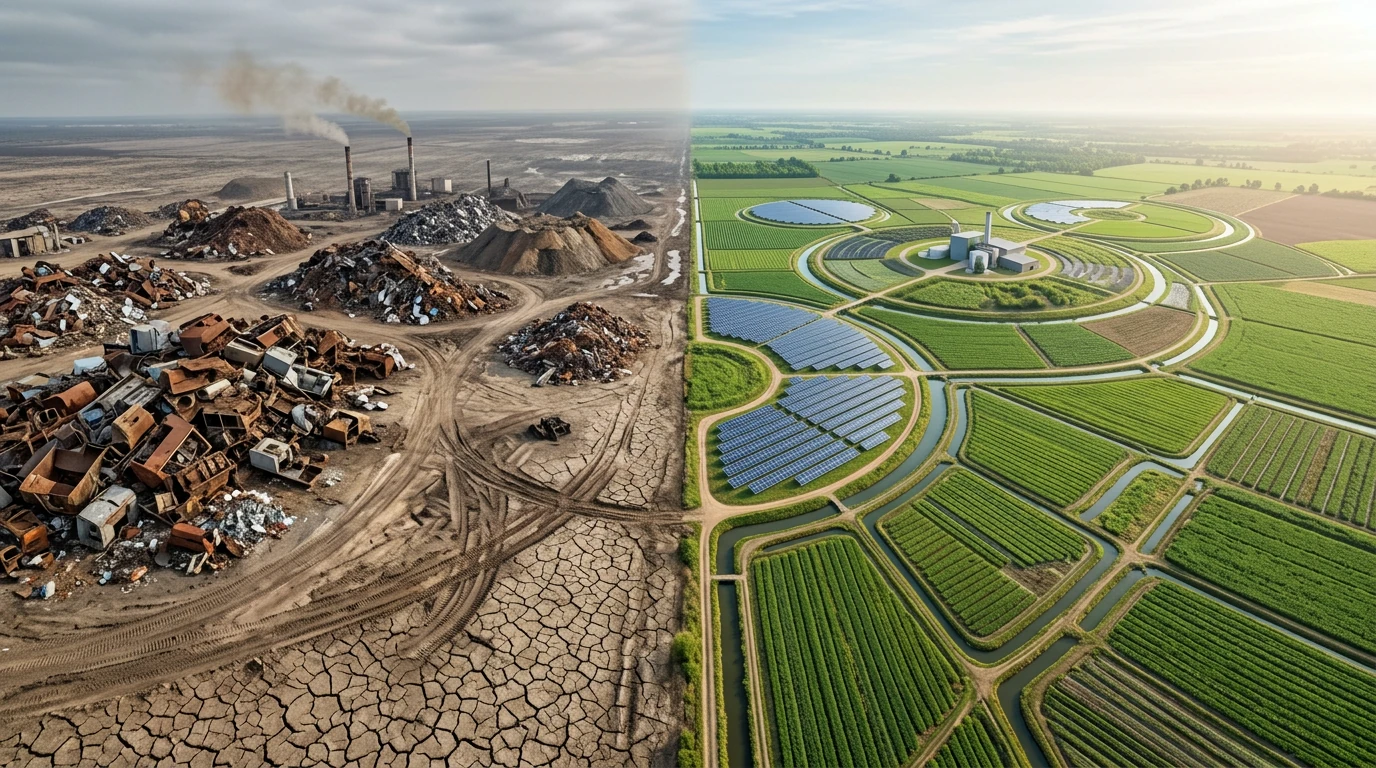
For over a century, our global economy has followed a straight line from extraction to disposal. We take resources from the earth, make products, and then throw them away when we’re done—a simple but profoundly wasteful model. This linear ‘take-make-waste’ system is now straining under its own weight, confronting resource scarcity, overflowing landfills, and a growing climate crisis. What if we could bend that line into a circle?
This is the core premise of the circular economy, a transformative framework that rethinks our entire relationship with material goods. It’s far more than an ambitious recycling program; it’s a systemic shift designed to eliminate waste and pollution from the outset, keep products and materials in continuous use at their highest value, and actively regenerate our natural systems. By decoupling economic growth from the consumption of finite resources, it offers a path toward a more resilient and sustainable future.
Anúncios
This article explores the key facets of this emerging economic model. We will examine the core principles that define circularity, the powerful technologies like AI and IoT that are making it possible at scale, and the innovative business models—from product-as-a-service to industrial symbiosis—that are reshaping industries. Finally, we’ll assess the global policy landscape and confront the significant challenges that stand in the way of a circular world.
Redefining Value: The Core Principles of a Circular Economy
For generations, our global economy has operated on a simple, linear path: we take resources, make products, and then dispose of them. This “take-make-waste” model is reaching its physical limits. It’s one of the most significant global shifts redefining our world, forcing us to ask a critical question. What if waste wasn’t an endpoint, but a resource?
Anúncios
This is the central idea behind the circular economy. It’s a system designed to be restorative and regenerative by intention. What most people miss is that this isn’t just a glorified term for recycling. It’s a complete rethinking of how we produce and consume goods, aiming to decouple economic activity from the consumption of finite resources. The entire system is built on a few core ideas.
Three principles form the foundation of this approach. The first is to design out waste and pollution from the very beginning. Next is to keep products and materials in use for as long as possible through repair, reuse, and remanufacturing—a far cry from today’s disposable culture. Finally, the goal is to regenerate natural systems, actively improving the environment, much like the focus of global renewable energy innovations.
The economic case is just as compelling as the environmental one. A report from the World Economic Forum suggests that adopting circular principles could generate an estimated $4.53 trillion in new economic opportunities. This isn’t just about saving the planet; it’s about building a more resilient and profitable economic future.
Technological Catalysts: Innovations Powering Circularity
The concept of a circular economy isn’t new, but its practical application at scale is a recent development. This shift is largely thanks to a suite of powerful technologies turning theoretical models into operational realities. Without these digital tools, tracking millions of products through complex lifecycles would be like trying to manage a global shipping network using only paper maps. It just wouldn’t work.
Digitalization acts as the central nervous system for circularity, connecting products, users, and recyclers in a continuous feedback loop. From artificial intelligence that optimizes reverse logistics to advanced materials designed for disassembly, technology is the critical enabler. It provides the visibility and intelligence needed to keep resources in use for as long as possible.
AI and IoT: Enabling Smart Resource Management
The Internet of Things (IoT) provides the eyes and ears of the circular economy. By embedding small, low-cost sensors into products and packaging, companies can track an item’s location, condition, and usage history throughout its entire life. This creates a “digital passport” for every product. A recent report from Accenture suggests that applying AI to these kinds of circular strategies could add trillions to the global economy. What most people miss is how this data transforms waste into a resource. Suddenly, a discarded smartphone isn’t just trash; it’s a known quantity of valuable metals ready for recovery.
Artificial intelligence then acts as the brain, processing the immense data streams from IoT devices to make smart decisions. AI algorithms can predict when a machine component is about to fail, scheduling preventative maintenance instead of costly replacement. These systems can also optimize complex reverse supply chains, determining the most efficient routes for collecting used products. This level of automation is closely related to the development of autonomous AI agents that can manage these processes with minimal human input. It’s all about making resource recovery profitable and predictable.
This creates a system that learns and improves over time.
Advanced Materials for Longevity and Recyclability
Technology’s role extends deep into the physical world through materials science. Scientists are now engineering materials with end-of-life in mind from the very first step. This includes everything from bioplastics that can be composted to new alloys designed for infinite recyclability without quality loss. The underrated factor here is the sheer complexity of molecular design needed to achieve this.
For example, companies are developing “self-healing” polymers that can repair minor cracks and scratches, dramatically extending a product’s lifespan. Others are focusing on chemical recycling processes that break down plastics into their pure molecular building blocks — a far more effective method than traditional mechanical recycling. Sorting these complex materials often requires refined systems, where robotics and automation play a significant part in identifying and separating different waste streams with high precision. This ensures that the feedstock for new products is as pure as possible.
The next challenge is not invention but scaling these material innovations so they become the standard, not the expensive exception.
The circular economy is a systems solution framework that tackles global challenges like climate change, biodiversity loss, waste, and pollution.
— Dame Ellen MacArthur, Founder of the Ellen MacArthur Foundation
| Aspect | Linear Economy | Circular Economy |
|---|---|---|
| Core Principle | Take-Make-Waste | Design Out Waste, Regenerate |
| Resource Flow | One-way street to landfill | Closed-loop, continuous cycle |
| Product Lifecycle | Short, ending in disposal | Extended through repair, reuse, remanufacture |
| Value Creation | Selling new units | Providing services, durability, and recovery |
| Economic Goal | Maximize production and consumption | Decouple growth from resource consumption |
Emerging Business Models: Beyond Take-Make-Dispose
The traditional linear economy, built on a simple “take-make-dispose” sequence, is showing its age. Its inefficiency and waste are becoming liabilities in a resource-constrained world. In its place, new business models are emerging that treat products and materials as assets to be preserved, not as disposable commodities. These frameworks are the engine of the circular economy, fundamentally reshaping how value is created and maintained.
Product-as-a-Service: Shifting from Ownership to Access
One of the most significant shifts is the move toward Product-as-a-Service (PaaS). Instead of selling a physical item, companies offer the benefit of that item on a subscription or pay-per-use basis. Think of it like subscribing to a music streaming service instead of buying CDs; you get the function without the burden of ownership. For example, Philips offers “Light as a Service” to corporate clients, selling illumination levels rather than light bulbs. This simple change completely alters the company’s incentives.
Suddenly, durability and efficiency are profit centers.
Benefits for Consumers and Manufacturers
For consumers, the advantages are clear: lower upfront costs, zero maintenance headaches, and continuous access to updated technology. Manufacturers, in turn, gain predictable, recurring revenue streams and a direct relationship with their customers. The underrated factor here is control over the product’s end-of-life. A report from the Ellen MacArthur Foundation highlights that by retaining ownership, companies can ensure materials are properly recovered, creating closed-loop systems that reduce reliance on virgin resources. They can design for disassembly from the start.
The Rise of Repair, Reuse, and Refurbishment
A powerful countercurrent to throwaway culture is the resurgence of repair and reuse models. This isn’t just about mending a torn shirt; it’s a refined business strategy. Companies are creating certified refurbishment programs and secondary markets for their own goods. Patagonia’s Worn Wear program, for instance, buys back used gear, repairs it, and resells it—extending the product’s life while capturing a new revenue stream. This approach builds immense brand loyalty.
These models are a key component of the broader global shifts redefining our world, moving consumption from a single transaction to a long-term relationship.
Empowering Consumers with Longevity
This business model directly challenges planned obsolescence. What happens when a company’s financial success is tied to how long its products last? Consumers feel more connected to brands that help them maintain and repair their possessions. This trend is supported by the growing “Right to Repair” movement, which advocates for legislation requiring manufacturers to make parts, tools, and service information available to the public. It puts power back into the hands of the owner.
Industrial Symbiosis and Resource Sharing Networks
At a larger scale, industrial symbiosis treats an entire industrial park like a single ecosystem. One facility’s waste becomes another’s raw material. The classic example is the Kalundborg Symbiosis in Denmark, where a power plant’s excess heat warms homes and fish farms, and its by-products are used to make cement and wallboard. This interconnectedness—much like the logic behind smart energy grids—creates incredible resource efficiency.
While large-scale examples are impressive, data suggests even smaller, regional networks can cut waste disposal costs by over 40% for participating companies. These collaborations turn waste from a costly problem into a valuable asset, proving that environmental and economic goals can align perfectly.
Global Adoption and Policy Landscape: A Collaborative Future
The transition to a circular economy isn’t happening uniformly across the globe, but the momentum is undeniable. Some regions are sprinting ahead while others are just starting to tie their laces. The European Union, for instance, has been a frontrunner with its detailed Circular Economy Action Plan, which sets ambitious targets for recycling, waste reduction, and sustainable product design. This plan acts less like a rigid blueprint and more like a shared language for member states to build upon.
Nations in Asia, particularly China and Japan, are also making significant strides. China has integrated circular principles into its five-year plans for over a decade, focusing on industrial parks and resource efficiency. It’s a massive undertaking. The data suggests—though not conclusively—that these top-down approaches can accelerate adoption significantly when backed by political will.
Key Policy Frameworks and Incentives
Governments are realizing their role is to be more of a coach than a referee. They are setting the rules of the game through policies that encourage circularity. This includes everything from Extended Producer Responsibility (EPR) laws, which make manufacturers responsible for the entire lifecycle of their products, to tax incentives for companies that use recycled materials. According to a report from the Organisation for Economic Co-operation and Development (OECD), 38 of its member countries now have national circular economy strategies in place.
Financial mechanisms are also a critical piece of the puzzle. Green bonds and public-private funds dedicated to circular projects are channeling capital toward sustainable innovation. These policies are not just about environmental protection; they are increasingly seen as integral to economic resilience and are often linked with other major initiatives, like the development of smarter and more efficient energy grids.
Corporate Commitments and Cross-Sector Partnerships
Policy alone can’t complete the circle. The private sector is stepping up, with major corporations across industries pledging to redesign their supply chains. We’re seeing tech giants commit to using 100% recycled cobalt in their batteries and fashion brands launching take-back programs to turn old clothes into new fibers. These aren’t just PR stunts anymore—they are core business strategies driven by consumer demand and investor pressure.
These individual efforts are amplified through cross-sector partnerships. For example, a chemical company might partner with a mattress manufacturer to develop a fully recyclable foam, creating a closed-loop system that benefits both. But are these voluntary commitments enough to drive systemic change? Many experts argue that while corporate leadership is necessary, binding regulations are needed to level the playing field and ensure widespread adoption. This collaborative tension is one of the key megatrends redefining our world.
The next challenge is standardizing metrics and reporting to measure progress and avoid greenwashing, ensuring that commitments translate into tangible results.
Challenges and the Road Ahead for Circular Transformation
The vision for a circular economy is clear and compelling, but implementing it is anything but simple. Despite the obvious environmental and economic benefits, the transition from a linear “take-make-waste” model faces significant real-world friction. These hurdles are not minor speed bumps; they are substantial barriers related to infrastructure, human behavior, and entrenched economic systems.
Successfully navigating these challenges requires a clear understanding of where the system breaks down. It’s a complex puzzle. The path forward involves more than just good intentions; it demands systemic change and targeted investment.
Overcoming Infrastructure and Supply Chain Gaps
Our global supply chain was built for a one-way trip: from resource extraction to factory, to consumer, and finally to the landfill. A circular model requires a completely new network of roads for products and materials to travel back for reuse, repair, or recycling. This concept, known as reverse logistics, is currently one of the weakest links in the chain.
Developing this infrastructure is a massive undertaking. It’s the unglamorous but required plumbing needed to make circularity work on a large scale. Without efficient collection, sorting, and processing systems, even the best-designed recyclable products end up as waste.
Investment in Recycling and Remanufacturing
Building this new plumbing costs money—a lot of it. The Platform for Accelerating the Circular Economy (PACE) estimates the annual investment gap for circular infrastructure in key sectors hovers around $350 billion. This capital is needed for advanced sorting facilities, remanufacturing plants, and technology that can process complex composite materials. Without significant financial commitment from both public and private sectors, these infrastructure gaps will remain.
The underrated factor here is the integration of these new systems with existing ones. For instance, a circular city needs more than recycling centers; it must connect them with innovations in smart energy grids to power operations sustainably. The entire ecosystem must be re-engineered, not just one part of it.
Shifting Consumer Mindsets and Market Demand
For decades, consumer culture has celebrated newness and disposability. The convenience of buying something, using it, and then simply throwing it away is a powerful habit ingrained across generations. But how do you convince millions of people to see “waste” as a valuable resource?
This psychological barrier is just as formidable as any physical one. The market has to shift from valuing single-use convenience to appreciating durability, repairability, and shared ownership models. This change won’t happen on its own.
Education and Awareness Campaigns
Meaningful change starts with education. Effective campaigns go beyond simple “recycle more” messaging and reframe the entire concept of ownership. They introduce consumers to product-as-a-service models—like renting tools or leasing clothing—that provide access without the burden of disposal. Some initiatives, like the Fairphone which is designed for easy repair, demonstrate that consumer demand for sustainable products exists when a viable alternative is presented.
What most people miss is that the circular option must be just as easy, if not easier, than the linear one. It has to compete on convenience. Think of it like ordering takeout; its success hinges on being simpler than cooking at home. The same principle applies here; returning a product for remanufacturing should be as effortless as tossing it in the trash.
Policy Harmonization and Global Standards
A global company trying to adopt circular practices today faces a bewildering patchwork of regulations. One country might ban a certain type of plastic while another encourages its use in recycled content. This lack of standardization creates immense operational friction and added costs, slowing down large-scale adoption.
Dr. Anya Sharma, a policy analyst with the World Resources Institute, explains that without global standards, “companies are essentially playing a different sport in every country.” Harmonizing policies around material traceability, recycling definitions, and product design is one of the basic global shifts needed to redefine our economic models. To push this transformation forward, a coordinated effort is required.
- Key Actions for Businesses:
- Invest in strong reverse logistics and closed-loop supply chains.
- Design products for durability, repairability, and disassembly from the very beginning.
- Explore new business models like rental, subscription, or pay-per-use to decouple revenue from material consumption.
- Collaborate with industry peers to create standardized material collection and recycling protocols.
- Key Actions for Policymakers:
- Implement Extended Producer Responsibility (EPR) laws that hold manufacturers financially responsible for a product’s entire lifecycle.
- Create financial incentives, such as tax credits or grants, for companies investing in circular infrastructure and innovation.
- Standardize material labeling and recycling symbols to reduce consumer confusion and improve sorting accuracy.
- Fund public education campaigns to build a widespread culture of reuse and repair.
The road ahead isn’t about finding a single solution. Instead, it involves making thousands of targeted improvements across supply chains, consumer habits, and regulatory frameworks. The next phase of the circular economy will likely be defined by how effectively we use technology, including emerging autonomous AI agents, to manage these complex systems and finally close the loop on a global scale.
What Is the Next Circle to Close?
The transition to a circular economy is clearly a marathon, not a sprint, requiring immense investment in infrastructure and core shifts in corporate strategy. Yet, as technology closes the logistical gaps and policies create level playing fields, the final and most complex barrier may not be physical but psychological. The linear economy has ingrained in us a culture of disposability and a constant desire for the new, a mindset that is often at odds with the principles of repair, reuse, and longevity.
While companies can design for durability and governments can incentivize recycling, these efforts will fall short without a corresponding evolution in consumer behavior. The most technical reverse logistics network is useless if people still choose to discard a repairable product. This raises a critical question for the road ahead: After we’ve optimized the systems and built the infrastructure, how do we redesign desire itself? The ultimate success of the circular economy may depend less on our ability to recycle materials and more on our willingness to redefine what it means to own, use, and value the things in our lives.
Frequently Asked Questions
What is the main difference between a linear and a circular economy?
A linear economy follows a ‘take-make-waste’ path, where resources are extracted, made into products, and then discarded. In contrast, a circular economy is a regenerative system designed to eliminate waste by keeping products and materials in continuous use through repair, reuse, and recycling.
How does technology contribute to the circular economy?
Technology is a key enabler of circularity. The Internet of Things (IoT) and AI help track products and optimize reverse logistics, while advanced materials science creates products that are durable, repairable, and easier to recycle at the end of their life.
What are some examples of circular business models?
Key circular business models include Product-as-a-Service (PaaS), where customers pay for use instead of ownership (e.g., subscribing to lighting). Other examples are certified refurbishment programs that resell used products and industrial symbiosis, where one company’s waste becomes another’s raw material.
What are the biggest challenges in implementing a circular economy?
The main challenges are the lack of infrastructure for reverse logistics (collecting and processing used products), the high initial investment required, and the need for a significant shift in both corporate practices and consumer behavior away from a disposable culture.
How can individuals contribute to the circular economy?
Individuals can contribute by prioritizing repair over replacement, buying secondhand or refurbished products, and supporting brands that offer take-back programs. Properly sorting waste for recycling and composting are also notable actions that support the broader circular system.