
The metaverse’s evolution hinges on pivotal hardware innovations, transforming user interaction and immersion for US consumers by 2026, encompassing advanced VR/AR, haptic feedback, and neural interface technologies.
Are you ready to dive deeper into the digital frontier? Navigating the Metaverse: 4 Essential Hardware Innovations for US Consumers in 2026 is becoming increasingly critical as the metaverse evolves from a concept into a tangible reality, promising to redefine how we work, play, and connect. For US consumers, understanding the underlying hardware driving this evolution is key to unlocking its full potential. What groundbreaking devices will shape our virtual experiences?
The Dawn of Next-Generation VR Headsets: Beyond Vision
The metaverse, a persistent and interconnected virtual world, demands hardware that can seamlessly bridge the physical and digital realms. At the forefront of this evolution are next-generation VR headsets, which are rapidly moving beyond simple visual displays to offer truly immersive experiences. By 2026, these devices will be lighter, more powerful, and feature enhanced capabilities that make virtual interactions feel indistinguishable from reality.
Current VR headsets, while impressive, often suffer from limitations such as resolution, field of view, and comfort. The next wave of innovation addresses these challenges head-on, integrating advanced optics and processing power to deliver unparalleled visual fidelity. Expect to see micro-OLED displays with resolutions far exceeding 4K per eye, virtually eliminating the ‘screen door effect’ and making virtual environments incredibly sharp and lifelike.
Enhanced Optics and Display Technology
- Micro-OLED Screens: Offering superior contrast, true blacks, and higher pixel density for crystal-clear visuals.
- Pancake Lenses: Reducing the form factor of headsets, making them slimmer and more comfortable for extended wear.
- Dynamic Foveated Rendering: Optimizing processing power by only rendering the area where the user is looking in high detail, improving performance and visual quality.
Beyond visual enhancements, future VR headsets will also incorporate advanced eye-tracking and facial expression tracking. This allows for more realistic avatar interactions, as your virtual self can mirror your real-world emotions and gaze. Imagine a virtual meeting where your avatar naturally makes eye contact and conveys subtle expressions, fostering a deeper sense of presence and connection. This level of detail will be crucial for professional applications within the metaverse, from collaborative design to remote training.
The leap in VR headset technology by 2026 will not only improve existing virtual experiences but also unlock entirely new possibilities, making the metaverse a more accessible and engaging space for a broader audience of US consumers. The focus on comfort, realism, and intuitive interaction will be paramount in driving widespread adoption.
Haptic Feedback Systems: Touching the Digital World
One of the most significant barriers to true metaverse immersion has been the lack of tactile feedback. While visuals and audio can transport us, the inability to feel virtual objects or interactions breaks the illusion. This is where advanced haptic feedback systems come into play, promising to revolutionize how we interact with digital environments by allowing us to ‘touch’ the metaverse.
By 2026, haptic technology will move beyond simple vibrations in controllers. We’re talking about sophisticated gloves, suits, and even localized skin patches that can simulate textures, temperatures, and resistance. Imagine picking up a virtual cup and feeling its weight and surface, or experiencing the impact of a virtual handshake. This level of sensory input will add an unprecedented layer of realism to virtual experiences.
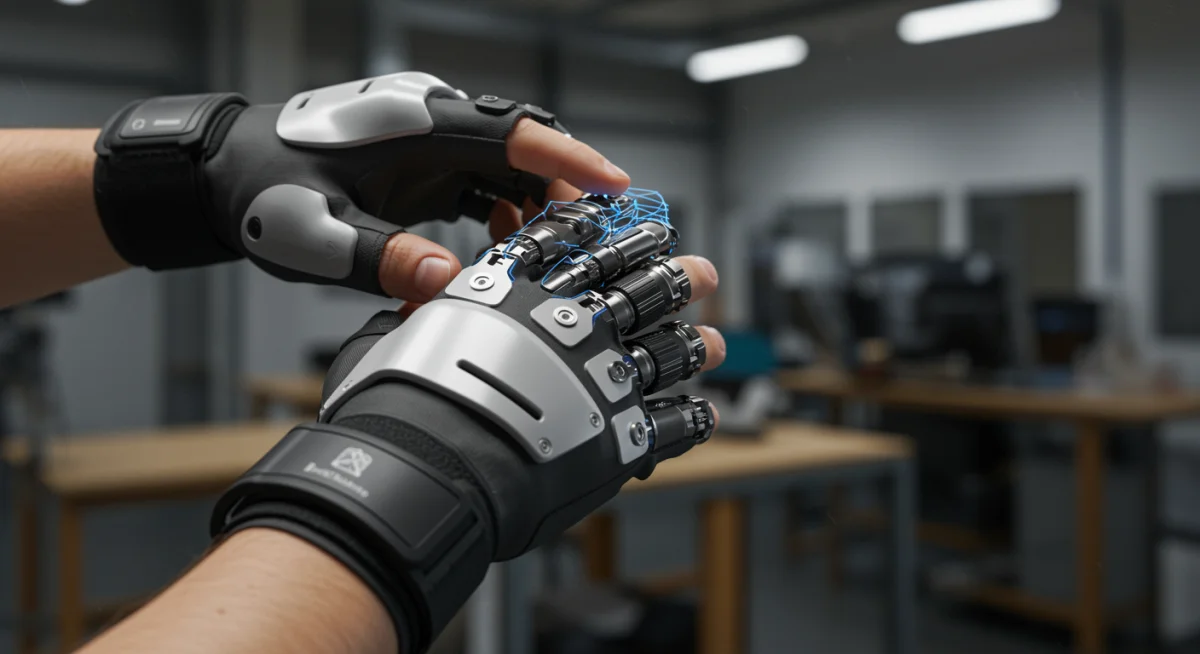
The development of haptic gloves is particularly exciting. These gloves are designed with an array of tiny actuators that can apply pressure, vibration, and even temperature changes to the wearer’s fingers and palm. This enables users to feel the shape, texture, and rigidity of virtual objects, making tasks like sculpting, operating virtual machinery, or even playing virtual musical instruments incredibly intuitive and realistic.
Innovations in Haptic Technology
- Force Feedback Exoskeletons: Providing resistance to simulate the weight and rigidity of virtual objects, enhancing realism in virtual lifting or pushing.
- Thermal Haptics: Mimicking temperature sensations, allowing users to feel the warmth of a virtual fire or the coolness of a digital ice cube.
- Electrotactile Stimulation: Using small electrical pulses to create a sensation of texture on the skin, offering a nuanced tactile experience without physical contact.
The implications of these advancements are vast, extending beyond gaming and entertainment. In fields like remote surgery, engineering, and education, haptic feedback will allow professionals to perform delicate tasks with greater precision and understanding. For US consumers, this means a metaverse where every interaction, from shopping to social gatherings, feels profoundly more real and engaging. The ability to truly feel the digital world will be a game-changer.
Augmented Reality Eyewear: Blending Worlds Seamlessly
While VR immerses us fully in a digital world, augmented reality (AR) eyewear aims to enhance our physical reality by overlaying digital information and objects onto our view of the real world. By 2026, AR glasses will become sleek, stylish, and powerful enough to be a daily companion for many US consumers, offering a seamless blend of the physical and virtual.
Current AR devices are often bulky or limited in their functionality. The next generation will feature significantly improved optics, wider fields of view, and advanced spatial computing capabilities. This means AR glasses will not only project clear, vibrant holograms but also accurately understand the physical environment, allowing digital objects to interact realistically with real-world surfaces and lighting conditions.
Key Features of Future AR Eyewear
- Waveguide Optics: Enabling thin, transparent lenses that project digital images directly into the wearer’s eye, maintaining a clear view of the real world.
- Advanced SLAM (Simultaneous Localization and Mapping): Allowing AR devices to build a real-time 3D map of the environment, crucial for accurate digital object placement.
- Contextual AI Integration: Providing relevant information based on the user’s surroundings, such as navigation overlays, product reviews in stores, or real-time translation during conversations.
The integration of AR eyewear into daily life will transform how US consumers access information and interact with their surroundings. Imagine walking down the street and seeing dynamic navigation arrows overlaid directly onto the pavement, or receiving real-time information about historical landmarks as you pass them. For professionals, AR glasses could provide heads-up displays for complex tasks, offering instructions or data without diverting attention from the physical world.
These devices will not only enrich our personal lives but also revolutionize industries, from manufacturing to retail. The ability to seamlessly blend digital content with our physical environment will make the metaverse less about escaping reality and more about enhancing it, creating a truly hybrid experience for users.
Neural Interfaces: The Ultimate Connection to the Metaverse
Perhaps the most ambitious and transformative hardware innovation for the metaverse by 2026 will be the emergence of practical neural interfaces. These devices aim to create a direct bridge between the human brain and digital systems, allowing users to control virtual environments, objects, and even communicate, using only their thoughts. While still in early stages, the rapid pace of development suggests significant breakthroughs.
The concept of direct brain-computer interaction has long been a staple of science fiction, but advancements in neuroscience and engineering are bringing it closer to reality. Non-invasive neural interfaces, such as advanced EEG headbands or even subtle earbud-like devices, are being developed to detect and interpret brain signals. These signals can then be translated into commands within the metaverse, offering an unparalleled level of intuitive control.
Frontiers in Neural Interface Development
- Non-Invasive EEG Devices: Capable of accurately mapping brain activity to specific intentions, enabling thought-based navigation and interaction.
- Targeted Neurostimulation: Potentially enhancing cognitive functions within the metaverse or even providing sensory input directly to the brain.
- Brain-to-Brain Communication: While highly experimental, the long-term vision includes direct thought transfer in virtual spaces, revolutionizing communication.
The potential of neural interfaces in the metaverse is profound. Imagine navigating complex virtual worlds, creating intricate digital art, or even composing music simply by thinking about it. This technology could democratize access to the metaverse for individuals with physical disabilities, offering them new avenues for expression and interaction. For all US consumers, it promises an experience that feels less like using a computer and more like an extension of one’s own mind.
While ethical considerations and safety protocols will be paramount in the development and deployment of neural interfaces, their potential to unlock unprecedented levels of immersion and control makes them a cornerstone of the metaverse’s future. By 2026, we may see the first widely accessible iterations of these devices, fundamentally changing the human-computer interface.
The Interconnected Ecosystem: Synergies of Innovation
The true power of these individual hardware innovations for Navigating the Metaverse: 4 Essential Hardware Innovations for US Consumers in 2026 doesn’t lie in their standalone capabilities, but in their synergistic interaction. By 2026, US consumers will experience a metaverse where these technologies converge, creating an ecosystem of unprecedented immersion and functionality. Imagine a scenario where a user dons a lightweight VR headset, feels virtual objects with haptic gloves, and navigates the environment with intuitive thought commands.
This interconnectedness will be facilitated by robust wireless communication technologies, such as Wi-Fi 6E and eventually Wi-Fi 7, providing the low latency and high bandwidth necessary for real-time data transfer between devices and the metaverse. Edge computing will also play a critical role, processing complex data closer to the user to minimize lag and enhance responsiveness. The seamless interplay between these hardware components will define the quality of metaverse experiences.
Building the Metaverse Foundation
- Unified SDKs and APIs: Developers will have easier access to tools that allow their metaverse applications to leverage multiple hardware inputs simultaneously.
- Open Standards: Encouraging interoperability between different hardware manufacturers, ensuring consumers aren’t locked into a single ecosystem.
- Portable Processing Units: Compact, powerful computing devices that can be worn or carried, offloading processing from headsets and allowing for lighter, more comfortable designs.
The goal is to create an experience where the hardware fades into the background, allowing the user to fully immerse themselves in the digital world. This level of integration will make the metaverse more intuitive and less cumbersome, lowering the barrier to entry for many. For US consumers, this means a future where engaging with virtual worlds is as natural and effortless as interacting with the physical one.
The industry is moving towards a future where these devices are not just accessories but extensions of our digital selves, providing a truly holistic metaverse experience. The convergence of these innovations will accelerate the metaverse’s growth, making it an indispensable part of daily life.
Challenges and the Path Forward for US Adoption
While the promise of these hardware innovations is immense, their widespread adoption among US consumers by 2026 faces several challenges. Cost remains a significant barrier; cutting-edge technology often comes with a premium price tag, potentially limiting initial access to early adopters. Furthermore, the content ecosystem needs to mature, offering compelling and diverse experiences that justify the investment in new hardware.
Comfort and usability are also paramount. Even the most advanced hardware will fail if it’s too heavy, causes motion sickness, or is overly complicated to set up and use. Manufacturers are actively working on ergonomic designs, intuitive interfaces, and solutions to common issues like VR sickness. The industry’s ability to address these human-centric design challenges will be crucial for mass market penetration.
Overcoming Adoption Hurdles
- Affordability: Increased competition and manufacturing efficiencies are expected to drive down prices, making advanced hardware more accessible.
- Content Development: A continuous influx of high-quality, diverse metaverse experiences will be essential to attract and retain users.
- User Experience (UX) Focus: Prioritizing comfort, ease of use, and seamless integration to ensure a positive first impression and sustained engagement.
Another critical aspect is data privacy and security. As these devices become more integrated into our lives and collect more personal data, including biometric information and even brain activity, robust frameworks for protecting user information will be essential. Building trust with consumers through transparent policies and secure technologies will be fundamental to fostering widespread acceptance.
Despite these hurdles, the trajectory of innovation is clear. With continued investment in research and development, a focus on user-centric design, and the establishment of ethical guidelines, the metaverse hardware of 2026 will be ready to transform the digital landscape for US consumers. The journey is complex, but the destination promises a new era of immersive digital interaction.
| Key Hardware Innovation | Brief Impact for US Consumers (2026) |
|---|---|
| Next-Gen VR Headsets | Ultra-realistic visuals, enhanced comfort, and intuitive interaction for deeper immersion in virtual worlds. |
| Advanced Haptic Systems | Tactile feedback (texture, weight, temperature) for realistic physical interaction with digital objects. |
| Sleek AR Eyewear | Seamless blending of digital information with the real world, enhancing daily life and professional tasks. |
| Emerging Neural Interfaces | Thought-based control and interaction, offering unparalleled intuitive connection to the metaverse. |
Frequently Asked Questions About Metaverse Hardware
Next-gen VR headsets will offer significantly improved visual fidelity with micro-OLED screens, greater comfort from pancake lenses, and more realistic avatar interactions through advanced eye and facial tracking. This leads to deeper immersion and more engaging virtual experiences for gaming, social, and professional applications.
Haptic feedback systems, like advanced gloves and suits, will allow users to ‘feel’ virtual objects. They can simulate textures, temperatures, and resistance, making digital interactions incredibly realistic. This will be crucial for tasks requiring precision, such as virtual surgery or design, and for general immersion.
VR headsets fully immerse users in digital worlds, whereas AR eyewear overlays digital content onto the real world. AR glasses aim to enhance physical reality by providing contextual information or virtual objects that interact with the physical environment, blending the digital and physical seamlessly for daily use.
By 2026, non-invasive neural interfaces, like advanced EEG headbands, are expected to become more accessible. While safety and ethical considerations are paramount and actively being addressed, these devices will offer intuitive, thought-based control over virtual environments, opening new avenues for interaction, especially for accessibility.
Key challenges include the high cost of cutting-edge hardware, the need for a robust and diverse content ecosystem, and ensuring user comfort and ease of use. Additionally, establishing strong data privacy and security frameworks will be crucial to build consumer trust and drive widespread adoption among US consumers.
Conclusion
The rapid evolution of hardware is undeniably the engine driving the metaverse towards its full potential. For US consumers looking to engage with this burgeoning digital frontier, understanding these four essential innovations—next-generation VR headsets, advanced haptic feedback systems, sleek AR eyewear, and emerging neural interfaces—is not just about staying current, but about preparing for a fundamental shift in how we interact with technology and each other. By 2026, these devices, working in concert, will transform the metaverse from a niche concept into an integral part of our daily lives, offering unprecedented levels of immersion, interaction, and utility. The journey ahead promises a future where the lines between the physical and digital continue to blur, opening up new realms of experience and possibility.